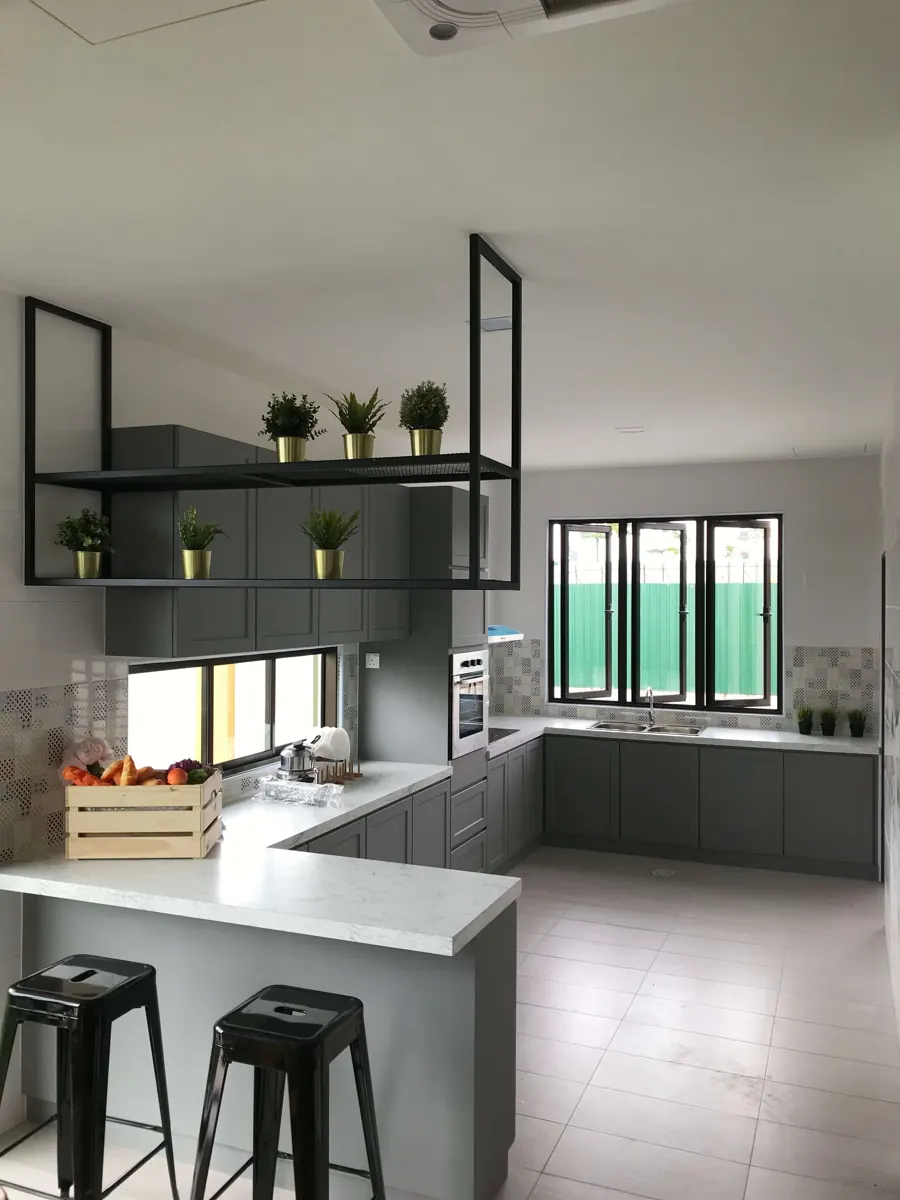
Most Malaysian landed homes work best with two kitchens: a closed wet kitchen at the back for frying and heavy cooking, and an open dry kitchen near the dining table for light jobs. For the layout, follow the shape of the room. A long, narrow wet kitchen suits a straight or galley layout, while a wider dry kitchen can take an L-shape, a U-shape or an island.
In short:
- Wet kitchen: gas hob, strong hood, main sink, wok cooking, washing up.
- Dry kitchen: fridge, oven or microwave, coffee, breakfast, serving.
- Narrow room (under about 2.4 m wide): straight or galley.
- Island only if the room is about 3.6 m (12 ft) wide or more.
- Leave roughly 1,000–1,200 mm of walkway between facing cabinets.
What is the difference between a wet and a dry kitchen?
A wet kitchen is where the smoke, oil and water happen, and a dry kitchen is where the clean, quick jobs happen. Malaysian cooking uses a lot of high heat: sambal, curry, fried fish, wok stir-fry. That grease travels. In an open plan it ends up on the sofa, the curtains and the ceiling.
Splitting the kitchen keeps the heavy cooking behind a wall or door. The dry kitchen stays clean enough to sit beside the dining table.
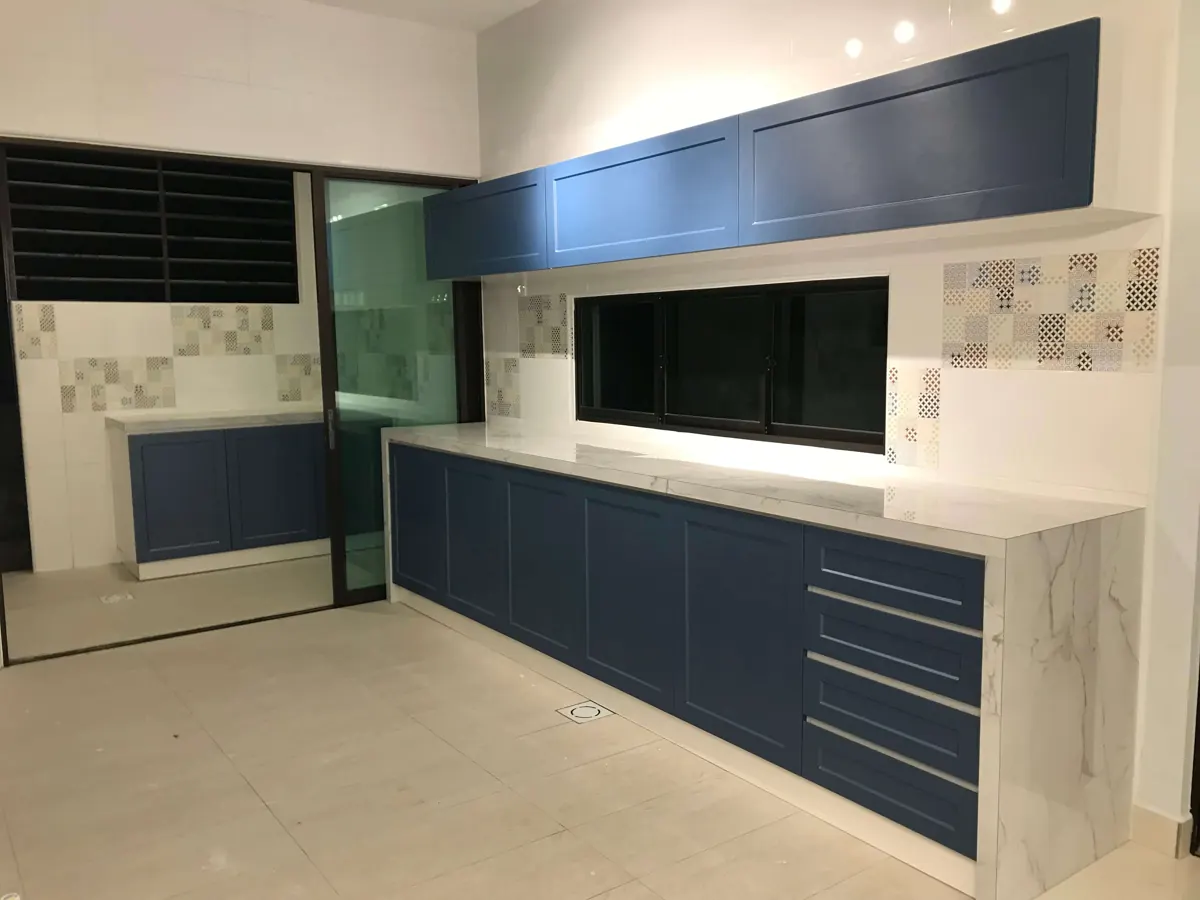
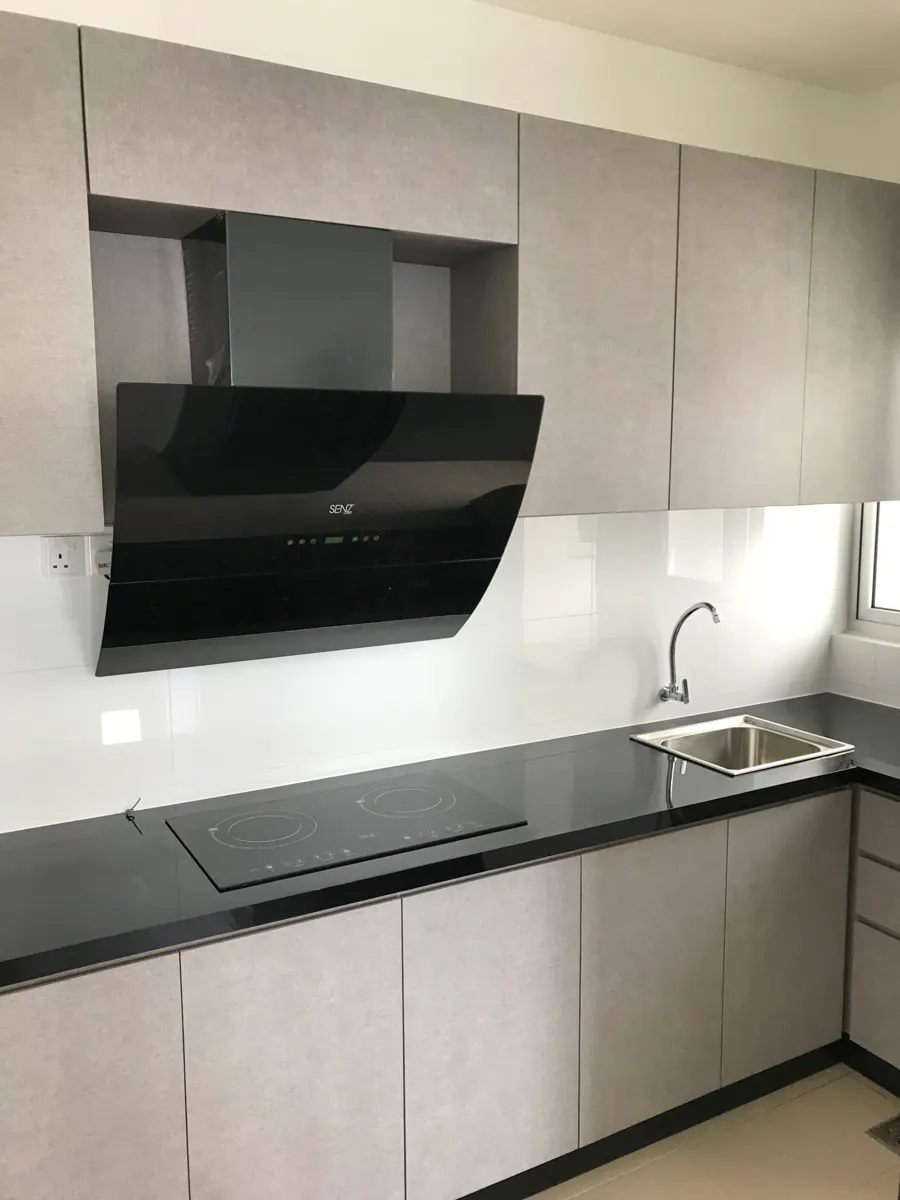 A wet kitchen run we built: hood, hob and sink on one wall, with wall cabinets above.
What goes in the wet kitchen and what goes in the dry kitchen?
Put anything that makes smoke, oil or a lot of water in the wet kitchen, and put the fridge, small appliances and serving space in the dry kitchen. The table below is how most Malaysian families split it.
| Item | Wet kitchen | Dry kitchen |
|---|---|---|
| Gas hob and wok cooking | Yes | No (an induction hob for light cooking is fine) |
| Cooker hood | Strong, ducted to the outside | Lighter hood, only if there is a hob |
| Main sink and dish rack | Yes | Small prep sink is optional |
| Fridge | Optional second fridge | Usually here |
| Oven, microwave, coffee machine | Rarely | Yes, often in a tall cabinet |
| Rice cooker, kettle, toaster | Either | Either, needs sockets at worktop height |
| Worktop | Hard-wearing: quartz, granite or tile | Quartz or laminate (HPL) |
The wet kitchen also gets more water on the floor and on the cabinet bases. That damp is why our default for cabinet bodies is plywood, faced with laminate (HPL) on the doors and surfaces. If you are choosing the worktop next, our quartz vs laminate table top comparison goes through the trade-offs.
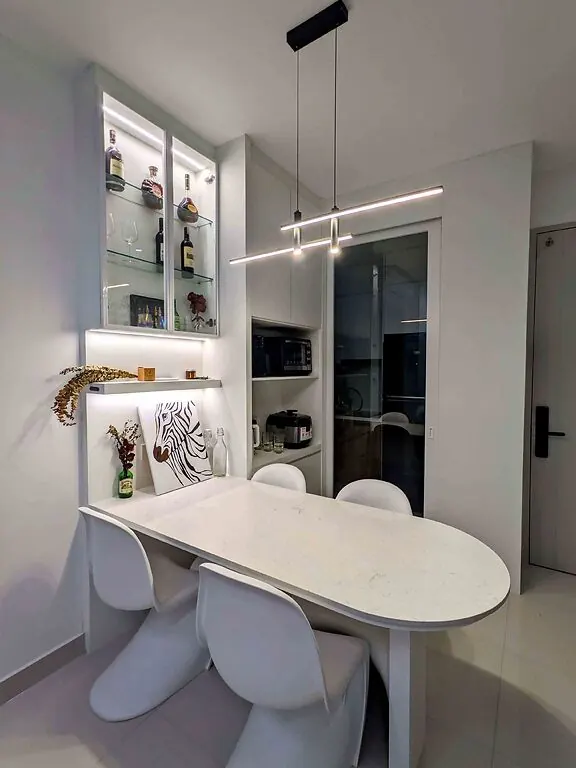 A dry kitchen corner: appliance shelf, display cabinet and dining table, with a glass sliding door closing off the cooking area.
Which kitchen layout fits a Malaysian terrace house?
For most terrace houses, the best fit is a straight or galley layout in the wet kitchen, and an L-shape or straight run in the dry kitchen. The back kitchen of a typical terrace house is long and narrow, often an extension built out towards the yard.
The dry kitchen usually opens onto the dining area. An L-shape there gives you worktop on two walls and keeps the middle of the room free for the table. If the space is about 3.6 m (12 ft) wide or more, you can consider an island or a counter with stools.
In condos and apartments, the kitchen is usually a single small room. A straight or L-shape is the common choice, with a glass sliding door to hold the smoke in.
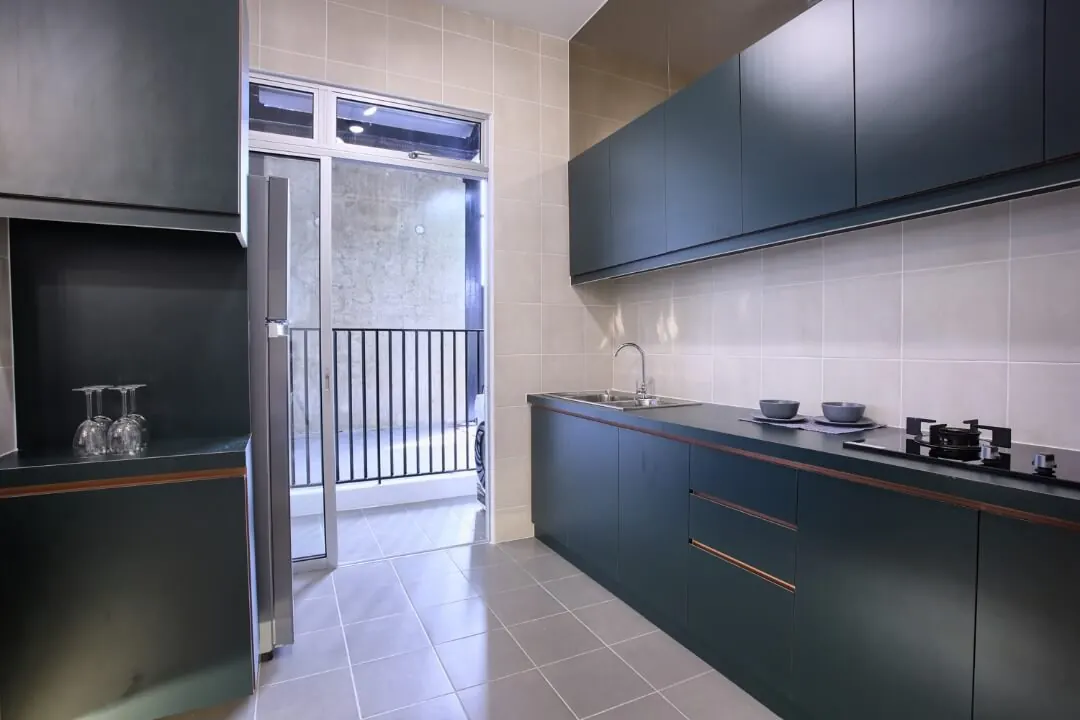 A narrow back kitchen: one long working run, with the fridge kept near the door so it stays out of the cooking path.
How do the five kitchen layouts compare?
Each layout suits a particular room shape, so measure the room first and then pick from this table. The sizes are rough planning figures, not rules.
| Layout | Best for | Rough minimum space | Pros | Cons |
|---|---|---|---|---|
| Straight (I-shape) | Narrow wet kitchen, studio, condo | One wall of about 2.4 m (8 ft) | Simplest, cheapest to build, leaves the floor open | Least worktop; you walk side to side |
| Galley (parallel) | Long, narrow wet kitchen | Room about 2.2–2.4 m wide | Short reach, lots of worktop for the floor area | Walkway is the only path; tight for two cooks |
| L-shape | Dry kitchen beside the dining area, condo | Two walls of about 1.8 m (6 ft) each | Open centre for a table; good corner storage | Corner cabinet is hard to reach without fittings |
| U-shape | Dedicated square kitchen room in a landed house | Room about 2.4 m wide or more | Most storage and worktop | Uses three walls; can feel closed in |
| Island | Large open dry kitchen | Room about 3.6 m (12 ft) wide | Extra worktop and seating; good for serving | Needs walkway on every open side |
Straight (I-shape)
All cabinets sit on one wall. It is the easiest to plan and usually the lowest cost, because there is no corner unit. The downside is short worktop, so plan a clear stretch of at least one cabinet width between the sink and the hob for chopping.
Galley (parallel)
Two runs face each other with a walkway in between. You turn around instead of walking, which is why it suits a narrow wet kitchen. Keep the gap at roughly 1,000–1,200 mm. Narrower, and two open cabinet doors will block each other.
L-shape
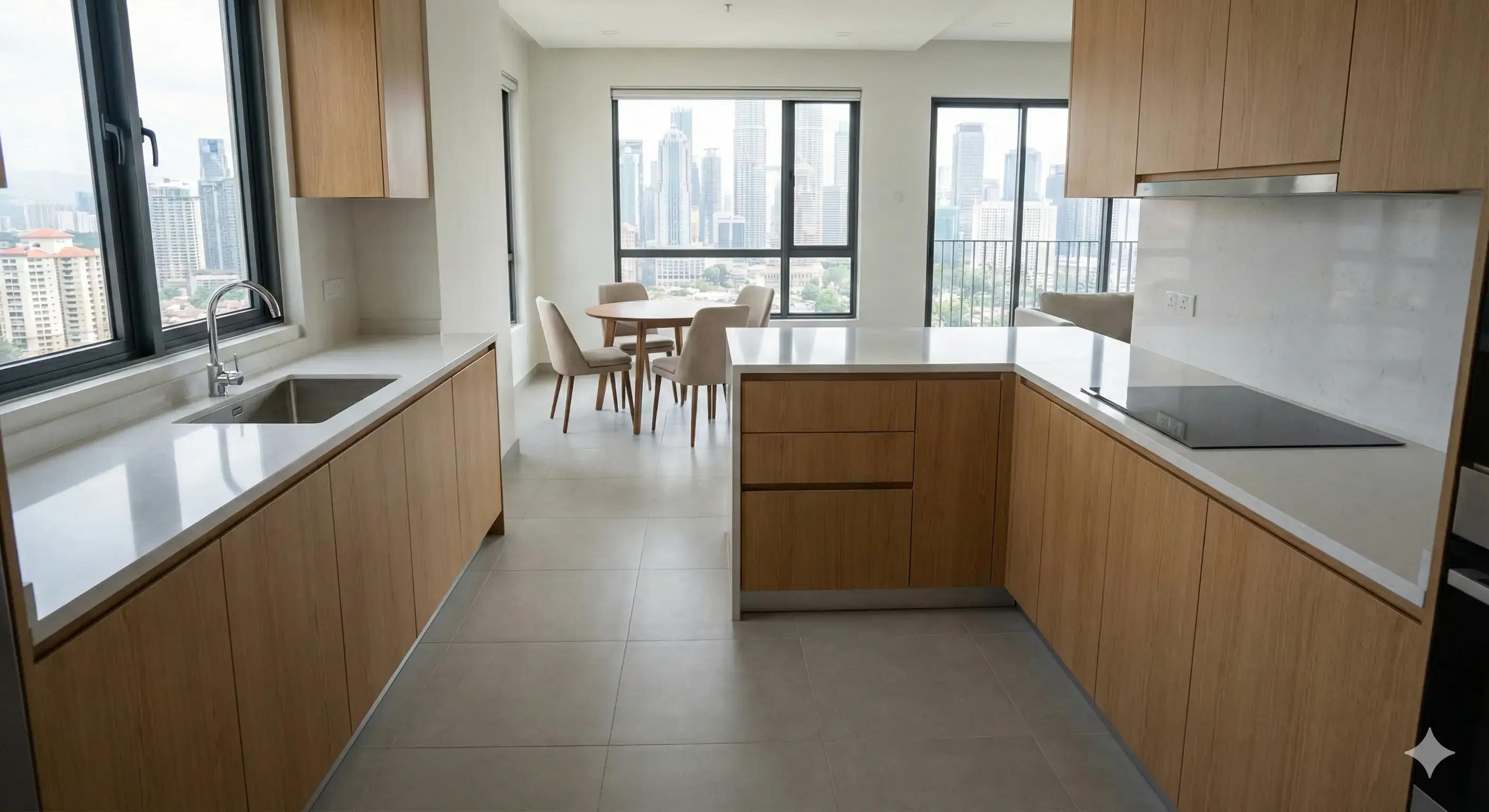
Cabinets run along two walls that meet in a corner. This is the most flexible layout for dry kitchens and condos. Ask for a corner fitting such as a magic corner or carousel, or the back of that corner cabinet becomes dead space.
U-shape
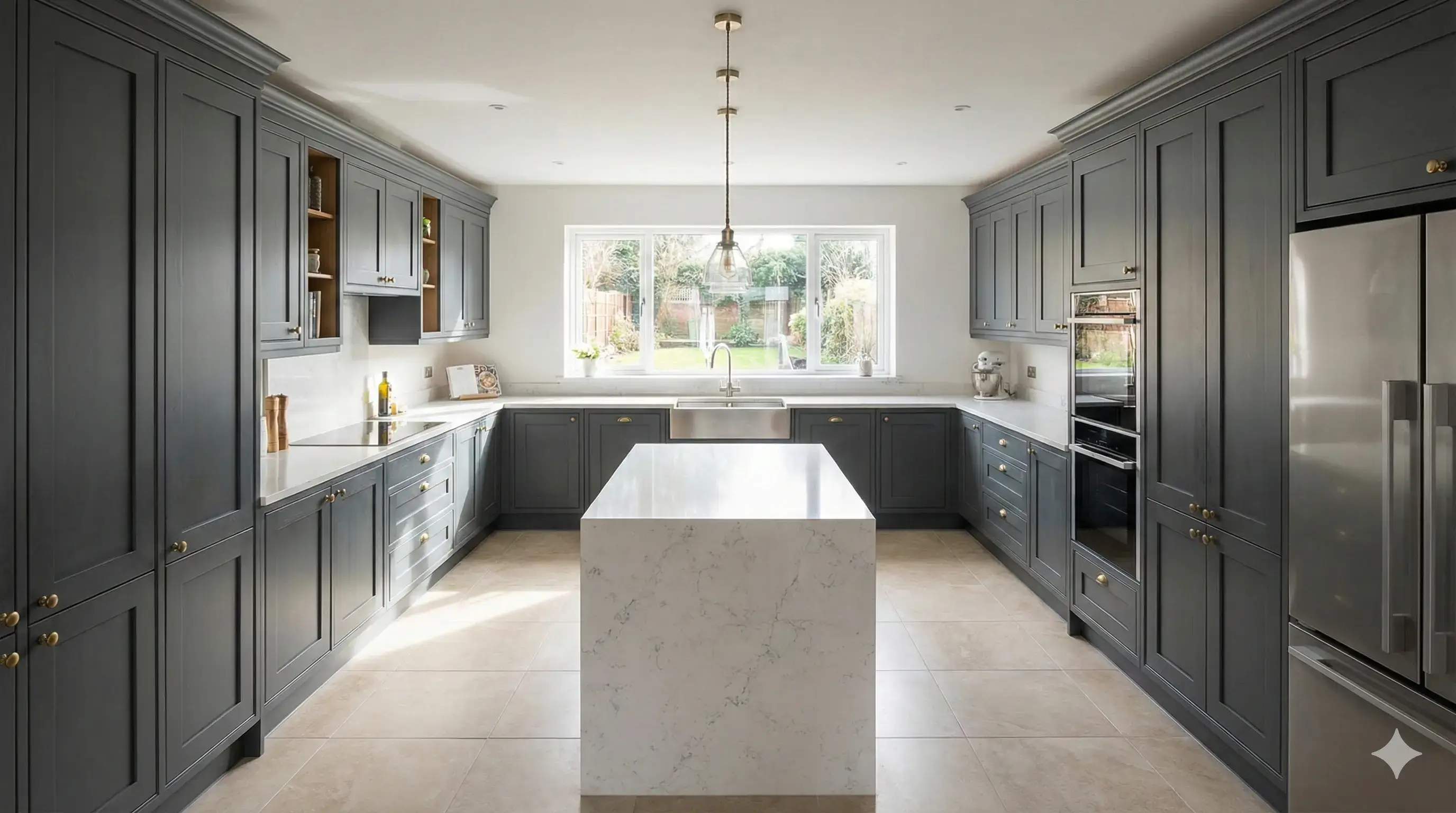
Cabinets cover three walls. You get the most storage and worktop, which suits a family that cooks every day. Check that the walkway between the two facing sides is still about 1,000 mm or more after the cabinets go in.
Island
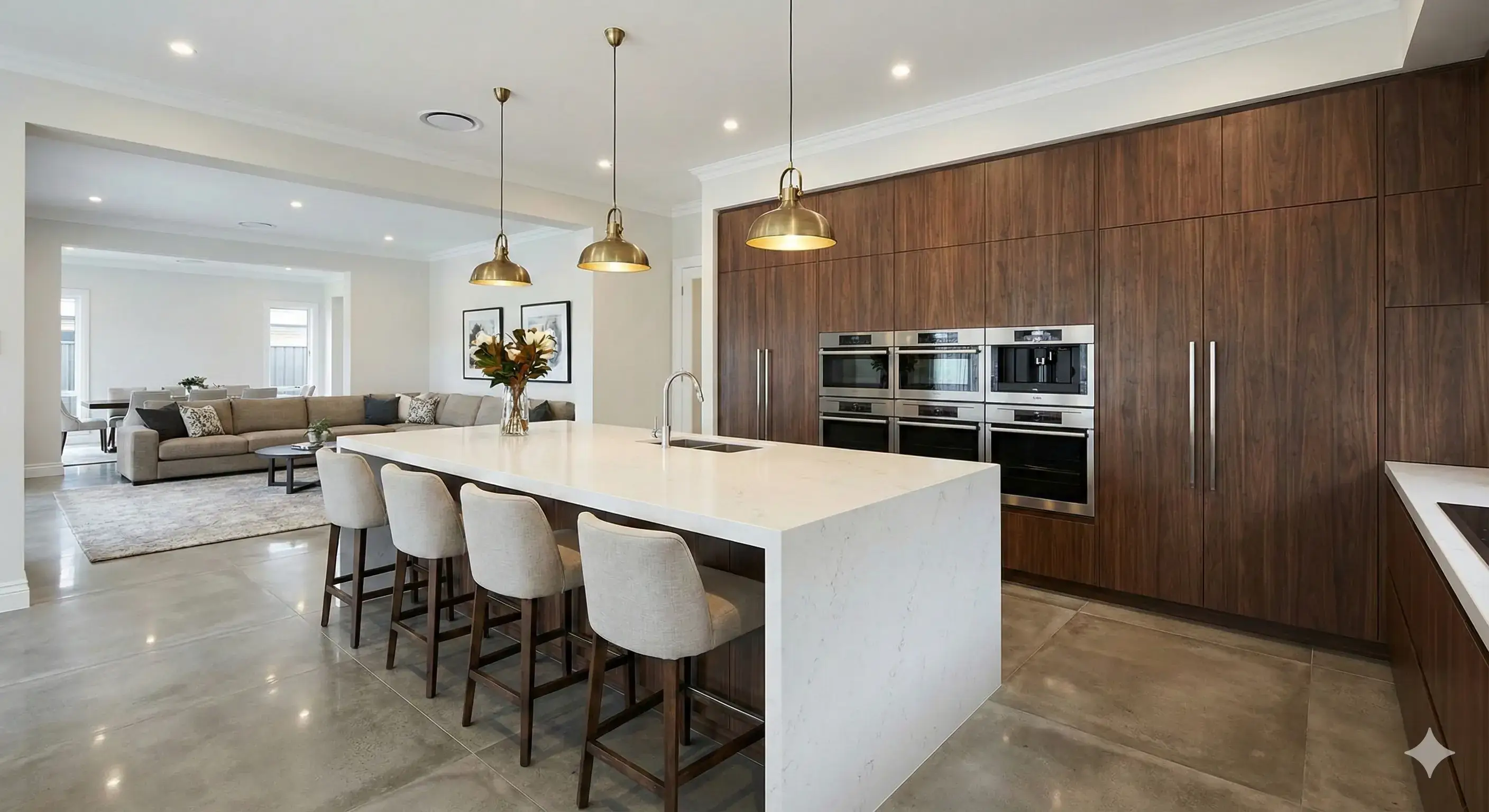
A freestanding block of cabinets sits in the middle of the room. It gives extra worktop and a place for children to sit while you cook. It also needs about 1,000 mm of clear floor on every side people walk. In a room narrower than about 3.6 m, choose a peninsula (a counter joined to one wall) instead.
How far apart should the sink, hob and fridge be?
A common planning rule, called the work triangle, says each leg between the sink, hob and fridge should be about 4 to 9 feet (1.2 to 2.7 m). The three legs together should stay under about 26 feet. Measure from the front centre of one to the front centre of the next.
In a split kitchen, apply the triangle to the wet kitchen and keep the fridge somewhere that does not force people to walk past the hot hob.
Also keep the hob away from a window that opens, so wind does not blow out the flame, and leave some worktop on both sides of the hob for setting down hot pots.
Can cabinets fit an odd wall or a beam?
Yes, if they are made to measure. Ready-made cabinet ranges come in fixed widths, so a 235 cm wall ends up with a filler panel or a gap. We measure on site, draw every cabinet and cut the boards in our own workshop, so the run is built to the wall you actually have. Beams, pipes and uneven walls are planned into the drawing.
If you only have a developer's PDF floor plan without measurements, our scale rule tool helps you read the wall lengths off the drawing before you talk to anyone.
What should you check before you confirm the layout?
Go through this list with whoever is drawing your kitchen:
- Where will the gas pipe or gas tank go, and is the hood ducted to the outside?
- Is there at least 1,000 mm of walkway between facing cabinets or the island?
- Can the fridge door, oven door and dishwasher open fully without hitting anything?
- Where are the sockets for the rice cooker, kettle and microwave?
- Does the corner cabinet have a fitting, or is it dead space?
- Which worktop goes in the wet kitchen and which in the dry kitchen?
- Is the cabinet carcass plywood, and what finish is on the doors?
For a rough budget, see our kitchen cabinet price guide for Malaysia. Layout changes the bill too: a short straight run is the cheapest shape, while an L or U adds a corner unit and more worktop. On the figures we publish, a small 10-ft straight run with upper and lower cabinets and a laminate top begins at around RM 9,000. Bigger L-shaped jobs topped with quartz or sintered stone usually land between RM15,000 and RM50,000, depending on length and material.
Planning a kitchen with us
Send us your floor plan and tell us who cooks and how often, and we will suggest a wet and dry layout that fits the room. WhatsApp us the plan with a few photos of the room. See how we make custom kitchen cabinets, or what we cover for homes around Seremban. If you would like to see board samples before deciding, ask to drop by the workshop in Galla Industrial Park.
Common questions about this topic
What is the difference between a wet kitchen and a dry kitchen?
A wet kitchen is the closed room, usually at the back of a Malaysian house, where the heavy cooking happens: frying, stir-frying, boiling and washing greasy pots. A dry kitchen sits in the open area near the dining table and is used for light jobs such as coffee, breakfast, cutting fruit and reheating food, so it stays free of smoke and oil.
Which kitchen layout is best for a terrace house?
Most Malaysian terrace houses suit a straight or galley wet kitchen at the back, because that room is long and narrow, plus an L-shaped or straight dry kitchen near the dining area. Add an island only if the dry kitchen is roughly 12 feet (3.6 m) wide or more, otherwise the walkway becomes too tight.
How wide should the walkway in a kitchen be?
Plan for roughly 1,000 to 1,200 mm of clear floor between facing cabinets, or between a cabinet run and an island. Around 1,000 mm works for one cook. If two people often cook at the same time, or the oven and dishwasher doors open into the walkway, aim closer to 1,200 mm.
Do I need both a wet and a dry kitchen in a condo?
Not always. Many condo units have room for only one kitchen. A common answer is a single kitchen with a glass sliding door between the hob area and the living room. The door keeps cooking smoke in, still lets light through, and you avoid giving up floor space for a second kitchen.
What is the kitchen work triangle?
The work triangle is the walking path between the sink, the hob and the fridge. A common planning rule says each side should be about 4 to 9 feet (1.2 to 2.7 m) long and the three sides together should stay under about 26 feet. Keep islands and tall cabinets out of that path.