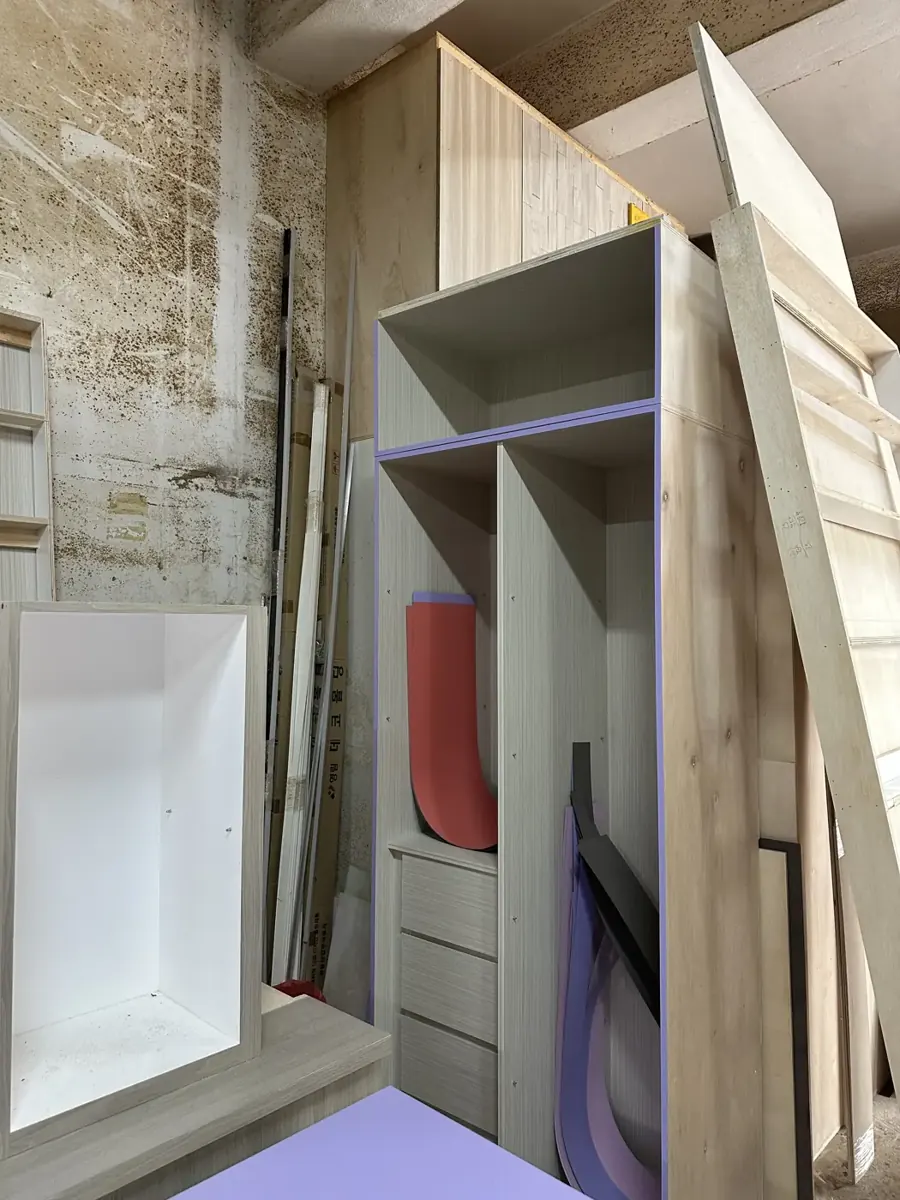
Factory-direct means the company that measures your kitchen and gives you the quotation also cuts the boards in its own workshop and installs them with its own team. There is no second company building the cabinets behind the scenes. That matters less for the price tag than for two things: your instructions reach the person cutting the board without being passed along, and one company stays responsible after handover.
In short:
- A factory-direct maker owns the machines and the installers. A reseller or coordinator does not.
- Between you and the board there can be a designer, a sales agent, a main contractor and a subcontracted carpenter. Each one has costs that end up in your quote.
- Factory-direct does not promise the lowest quote. It promises a shorter chain.
- You can check it in one visit: see the workshop, ask who installs, ask what cuts the boards.
What does "factory-direct" actually mean for kitchen cabinets?
Factory-direct means the business you sign with is the business that builds. It measures your space, draws each cabinet, cuts and edge-bands the boards, assembles the carcasses and sends its own people to fit them.
Many companies use the word loosely. Some own a design office and send the build to a carpentry workshop. Others buy flat-packed or ready-made carcasses and fit them. Both can do good work, but neither is making the cabinets themselves.
The test is simple. If the company could not build your kitchen next month without phoning another company, it is not factory-direct.
Who sits between you and the person cutting the boards?
In a typical Malaysian kitchen or wardrobe job, up to four layers can sit between the homeowner and the carpenter at the saw. Not every job has all of them, and nobody is obliged to tell you how many there are.
- Interior designer or ID firm. Draws the concept, picks finishes, often prepares 3D renders, and coordinates the project.
- Sales agent or renovation company. Finds the customer, writes the quote and handles the contract. Sometimes paid on commission.
- Main contractor. Books the trades (hacking, wiring, plumbing, tiling, ceiling) and passes the carpentry to a carpentry outfit.
- Subcontracted carpenter. The workshop that actually cuts the boards. When busy, it may pass the job on again to a smaller workshop.
At the end of that chain is the same thing every time: someone with a panel saw, an edge-banding machine and a van. Factory-direct simply means you are dealing with that person's company from the first visit.
What does each layer add to your quotation?
Each layer adds real work, and each layer also adds its own overheads and margin to the price you pay. The question is whether you need the work it adds.
| Layer | What it adds for you | What it adds to the bill | What can get lost |
|---|---|---|---|
| Interior designer / ID firm | Concept, finish selection, 3D renders, coordination | Design fee or markup on the build | Site details that only show up when measuring for cutting |
| Sales agent / renovation company | One point of contact, a quick quote | Office, marketing, commission | Exact board, edging and hinge spec |
| Main contractor | Books and sequences other trades | Management margin | Changes made late in the job |
| Subcontracted carpenter | The actual cutting and fitting | Its own margin, passed up the chain | Your direct line to the person building |
| Factory-direct workshop | Measuring, drawing, cutting and installing in one team | Board, hardware, machines, wages | Less design hand-holding if you want a full concept |
The money side is a mechanism, not a fixed number. Every company in the chain has rent and staff to pay, so each one prices that in before handing the job down. Fewer companies means fewer of those layers in your bill.
The information side matters just as much. You ask for a certain wood grain or a drawer 2 inches wider. That request passes from designer to contractor to carpenter. Each handover is a chance for a detail to drop. When the person you brief is the person who cuts, there is no one to pass it to.
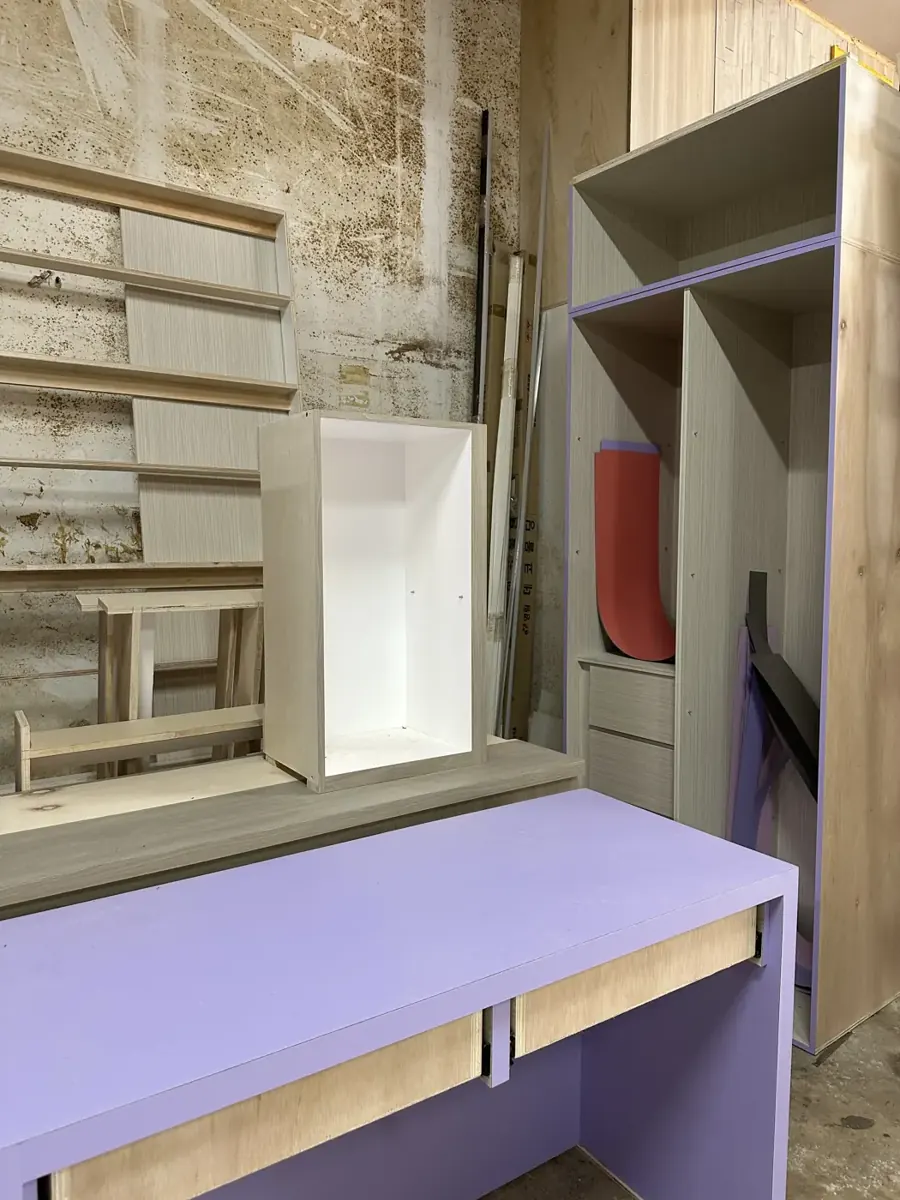 Pieces waiting in our Galla workshop before going out for installation.
Is factory-direct always cheaper?
No, a factory-direct quote is not always the lowest one you will receive. A workshop that cuts and installs its own work still pays for plywood, laminate, hinges, machines and wages, and that is reflected in the price.
What it removes is the extra margin of a company that only passes the job along. What it does not remove is the cost of good material.
A quote built from imported ready-made boxes and a piece-rate installer can come in lower. So compare like with like. Look at the carcass board, the finish, the edging and the hardware named on each quote. Our kitchen cabinet price guide breaks down typical per-foot rates by material.
Our own published bands give a feel for it. A small 10-ft kitchen (upper and lower cabinets, laminate worktop) begins at roughly RM 9,000. Bigger or L-shaped layouts topped with quartz or sintered stone usually land somewhere from RM15,000 up to RM50,000; the size and the top you pick decide where.
How can you check whether a company really builds its own cabinets?
Ask to visit the workshop where your boards will be cut, then ask who will install them. A real maker answers both questions straight away. Use this checklist before you pay a deposit:
- "Where is your workshop, and can I visit on a working day?" A maker gives an address and a time. A reseller talks about a "partner factory".
- "Who will install my cabinets, and are they your own team?" Look for the same people who built them, not a crew hired per job.
- "What machine cuts and edge-bands the boards?" A maker can name the saw and the edge-bander and show them running.
- "What carcass board and finish are in this quote?" A quote written by the builder lists board type, thickness, finish and hinges. "Kitchen cabinet package, 1 lot" is a sign the writer does not build it.
- "If a door drops after a year, who comes back?" You want a name you can message, not "we'll contact the supplier".
If any answer starts with "our supplier" or "our factory partner", you have found a layer. That is not automatically bad, but you now know who is really building your kitchen. Our post on how to choose a renovation contractor has more questions for the wider job.
When is a designer or main contractor the better choice?
A designer or main contractor is the better choice when you need a full concept for the whole house or someone to manage many trades at once. That coordination is real work, and paying for it can make sense.
If you are gutting a house, moving walls and redoing wiring, plumbing and ceilings, someone has to sequence those trades. Carpentry goes in last and depends on all of them being done right.
If you only need cabinets, wardrobes or built-ins, going direct is usually simpler. Many homeowners do both: a designer for the plan, a workshop for the carpentry. We compare the two roles in interior designer vs renovation contractor.
Why does building your own work matter for odd walls and sizes?
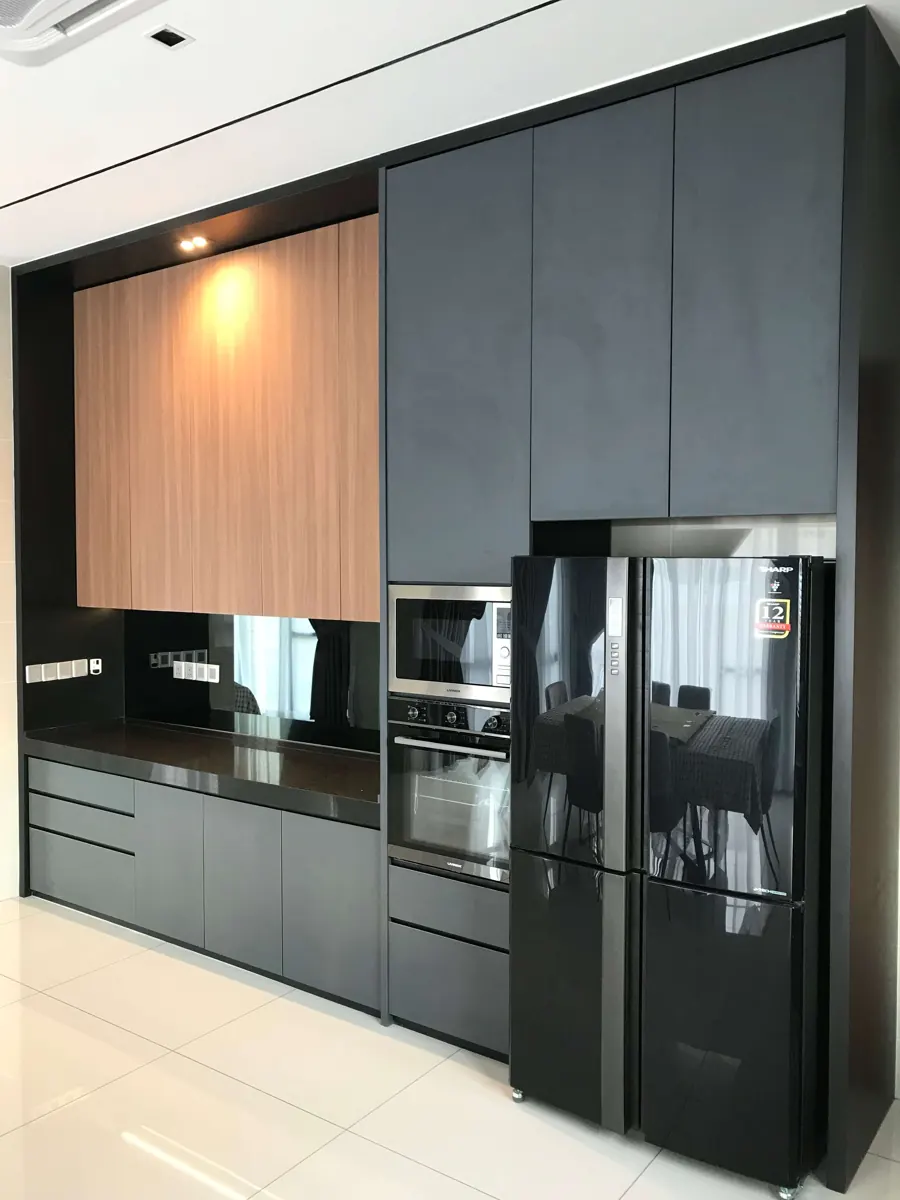
A workshop that cuts its own boards can make every cabinet to your actual wall, rather than fitting standard box sizes. Malaysian homes, from older terrace houses to newer condos, rarely have walls that are perfectly square.
When we measure, we note beams, pipes, power points and walls that lean. Each cabinet is drawn to those numbers and cut to them. A run built from ready-made boxes has to fill gaps with filler strips instead.
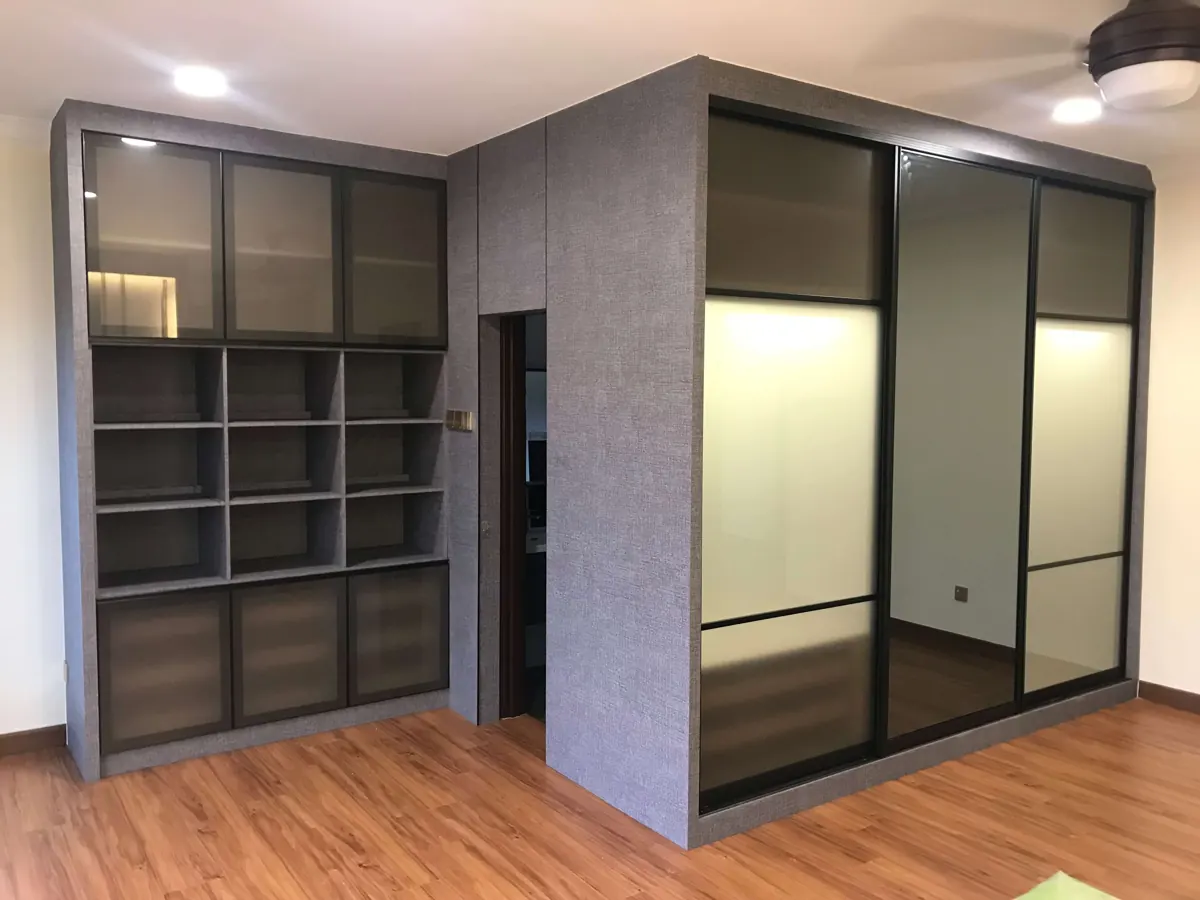
The same applies to wardrobes. Full-height units, sliding doors and wardrobes that wrap around a doorway all need cutting to the room.
What does factory-direct look like at Fatt Interior?
We are a small workshop at Galla Industrial Park, Seremban. Your space is measured by us, each cabinet is drawn by us, and the boards are cut and edged on our own machines. The people who fit them in your home are that same team. No outside contractor sits between you and the workshop.
For most kitchens our advice is plywood boxes finished in HPL laminate. Aluminium cabinets are not something we make. See our kitchen cabinets service for what is included, or our full renovation service if the cabinets are part of a bigger job.
Come and see the workshop
Shopping for kitchen cabinets in Seremban? If you want to see where they are made, ask to visit us at 239, Jalan Industri Galla 6, on a working day. A plan of the room or some phone photos helps. WhatsApp us to arrange a time, and we will walk you through the boards, the machines and a rough quote.
Common questions about this topic
What does factory-direct mean for kitchen cabinets?
Factory-direct means the company that measures your kitchen and gives you the quotation also cuts the boards in its own workshop and sends its own team to install. Nobody else builds the cabinets for them. If the company passes the build to an outside carpenter or buys ready-made boxes, it is a reseller or a coordinator, not a factory-direct maker.
Is a factory-direct cabinet maker always cheaper?
Not always. A workshop that does its own cutting and installing still pays for board, hardware, machines and wages. What changes is that your money is not also paying a second company's margin for passing the job along. A quotation built from imported ready-made boxes can still come in lower, so compare the materials written on each quote, not just the total.
How do I check if a renovation company has its own carpentry workshop?
Ask for the workshop address and ask to visit on a working day. Then ask who will install your cabinets and whether they are on the company's own team. A maker can answer both straight away and show you boards being cut. If the answers mention a supplier or a partner factory, the build is being passed to someone else.
Is there a kitchen cabinet factory in Seremban I can visit?
Yes. Fatt Interior's workshop is at 239, Jalan Industri Galla 6, Galla Industrial Park, 70200 Seremban. We measure, draw, cut and edge-band every cabinet there, and the same team installs it. Homeowners can ask to visit on a working day to see the boards and carcasses before deciding. Message us on WhatsApp at +60 13-338 6813 to arrange a time.
Should I hire an interior designer or go direct to a cabinet workshop?
If you only need kitchen cabinets, wardrobes or built-ins, going direct to a workshop keeps the person you brief close to the person who builds. If you want a full concept, 3D renders and someone to manage many trades across the house, a designer or main contractor earns their fee. Many homeowners use a designer for the plan and a workshop for the carpentry.