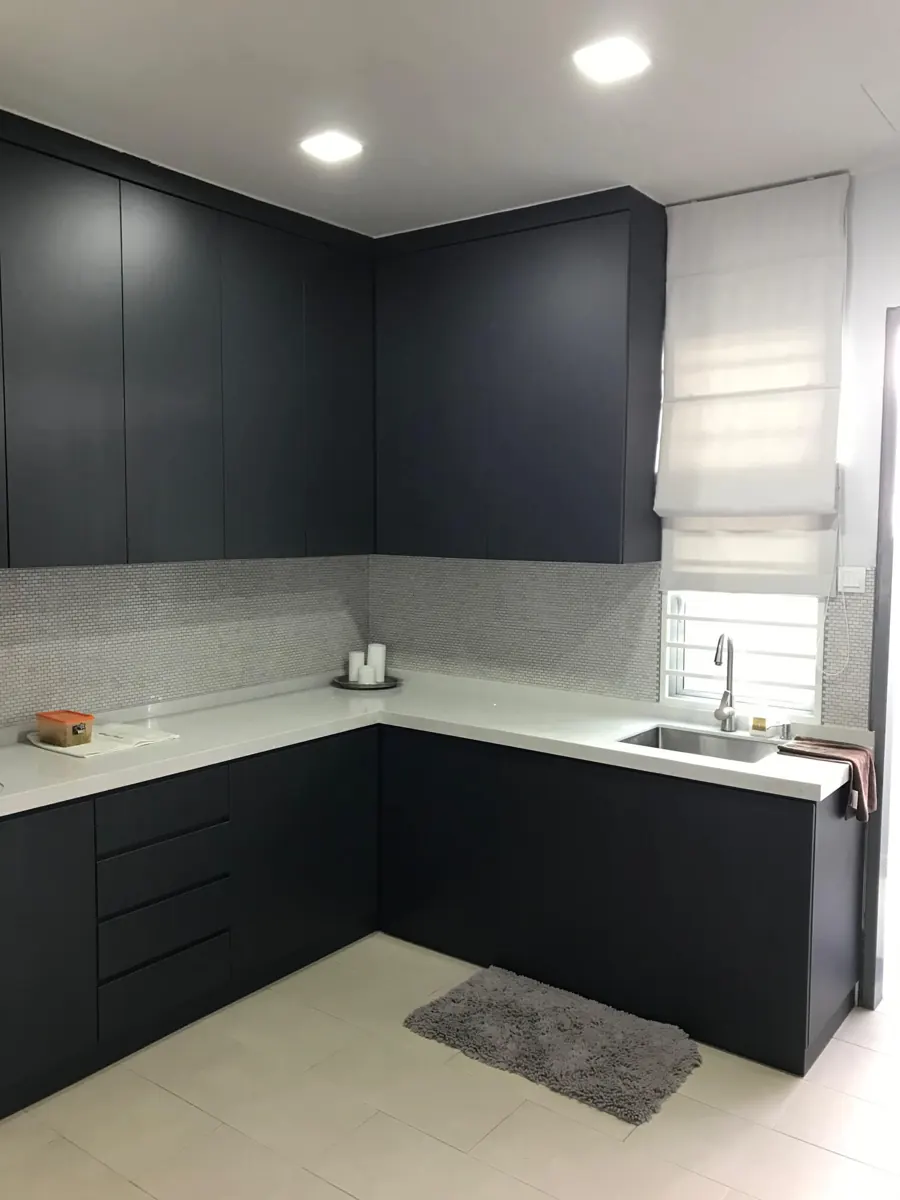
Kitchen cabinets in Malaysia cost about RM290 to RM600 per running foot for melamine and RM330 to RM600 for plywood, according to AmpQuartz (2026). Aluminium cabinets are listed higher, at RM400 to RM700 per running foot. The countertop, appliances and accessories are usually priced separately, so the per-foot rate is only part of the bill.
In short:
- A running foot is one foot of cabinet length along the wall. Base and wall cabinets are counted separately.
- Melamine and plywood share almost the same price band, so the rate alone does not tell you which board you are getting.
- Two quotes at the same rate can differ a lot in board thickness, edge sealing, hinges and drawers.
- Countertops are priced per square foot, on a separate line.
- All figures below are published market ranges, not Fatt Interior prices.
What is a running foot in a kitchen quotation?
A running foot is one foot of cabinet length measured along the wall, and nothing else. Height, depth and what sits inside the box (shelves or drawers) are not part of the unit.
That is why a wall with base cabinets and wall cabinets is counted twice: once for the bottom row and once for the top row. If a quote says "20 ft" for a 10-ft wall, it is probably counting both rows, which is normal. Just make sure you know which.
Corners and tall units are the other things to watch. On an L-shaped kitchen, some workshops count the corner once, some twice. Tall pantry or oven units are often priced as separate items, not per foot.
You can work out your own lengths before anyone quotes. Measure each wall on your floor plan with our free scale rule tool and write the base run and the wall run on separate lines.
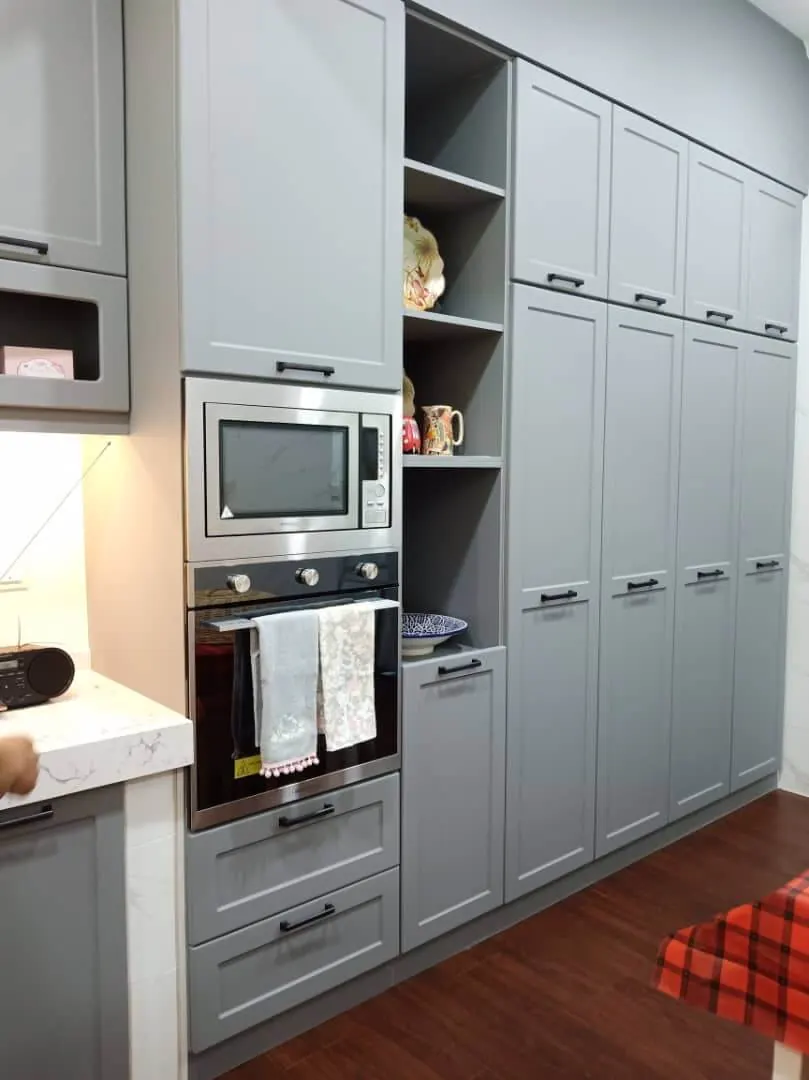 Tall units like these are often priced as separate items rather than per running foot.
How much is a kitchen cabinet per foot in Malaysia in 2026?
Published 2026 ranges run from RM290 per running foot for melamine up to RM700 for aluminium, with plywood starting at RM330. The bands overlap heavily, which is why you should always ask what is inside the box, not just the rate.
| Item | Published range (2026) | Unit | Source |
|---|---|---|---|
| Melamine-faced cabinets | RM290 to RM600 | per running foot | AmpQuartz, kitchen cabinet price guide |
| Plywood cabinets (solid ply) | RM330 to RM600 | per running foot | AmpQuartz, Johor kitchen cabinet buyer guide |
| Aluminium cabinets | RM400 to RM700 | per running foot | AmpQuartz, kitchen cabinet price guide |
| Quartz countertop | RM70 to RM190 | per square foot | AmpQuartz, quartz stone supplier page |
| Granite countertop | RM10 to RM500 | per square foot | AmpQuartz, granite table top price guide |
| Whole kitchen | RM10,000 to RM100,000 | per job | PropertyGuru Malaysia, Renovation House 2026 guide |
Our own published figures sit inside that bracket. A small 10-ft straight kitchen, top and bottom cabinets, with a laminate worktop, begins at around RM 9,000. Bigger kitchens and L-shapes, especially with a quartz or sintered stone top, usually land between RM15,000 and RM50,000. Size and the top you choose move it the most.
If you are also planning other rooms, our renovation cost estimator gives a rough whole-house figure from published ranges.
Why do two quotes at the same rate differ so much?
Two quotes at the same rate differ because the rate only describes length, while the real cost sits in the board, the hardware and the finishing. Here is what changes from one workshop to the next.
- Board thickness. An 18mm carcass holds screws and carries a loaded shelf without sagging. A thinner board looks the same on day one.
- Edge sealing. Water gets into board through cut edges. The bottom of side panels, the lower edge of doors and the pipe holes inside the sink cabinet need sealing. Ask about the pipe holes in particular.
- Back panel. A proper back panel fitted into grooves keeps the box square. A thin sheet stapled on the back does not.
- Hinges and runners. Soft-close hinges and drawer runners come in very different quality grades. Ask for the brand and the load rating of the runners.
- Drawers versus doors. A stack of three drawers is far more work than one door and a shelf. A flat rate across the kitchen means drawers have been averaged in.
- Accessories. Pull-out pantry units, corner units, wire baskets and lift-up doors are usually extra.
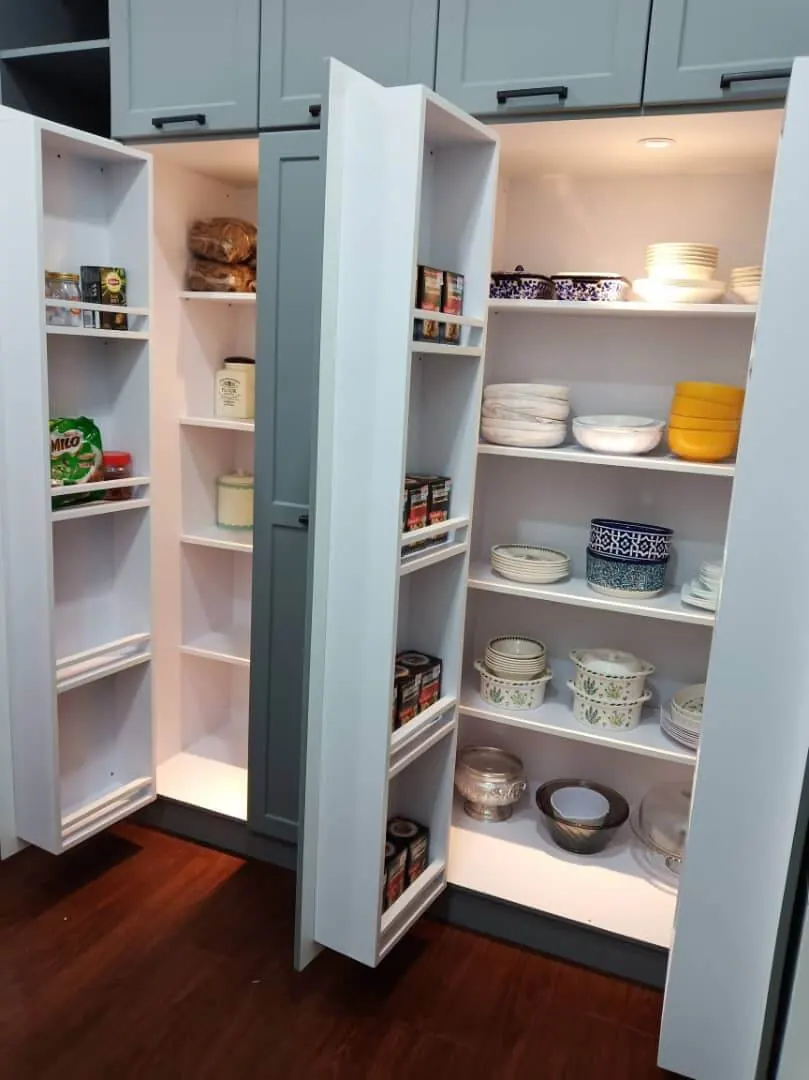 Pull-out pantry units add hardware and labour, so they are usually listed separately.
For a closer look at the boards themselves, see our kitchen cabinet materials guide.
Which material should I use for a wet kitchen?
For a Malaysian wet kitchen, our advice is plywood boxes faced with HPL laminate, with every cut edge sealed and the base cabinets standing on adjustable legs. That is what we build for wet and dry kitchens in our Seremban workshop.
Wet kitchens get mopped, steamed and splashed every day. Plywood holds screws well and copes with damp better than particle board, and laminate takes heat and scrubbing. Raising the cabinets off the floor keeps the board away from standing water and lets you reach a leaking pipe early.
Aluminium cabinets are also sold in Malaysia. AmpQuartz (2026) lists them at RM400 to RM700 per running foot. They do not swell or attract termites, but they can dent, sound hollow and offer fewer door finishes. We do not build aluminium cabinets, so if you want one, a specialist aluminium supplier is the right person to ask.
What is not included in a per-foot price?
A per-foot rate normally covers the cabinet boxes, doors, shelves and basic hardware. Most other items in the kitchen are quoted separately. Use this table to check your quote.
| Item | Usually in the per-foot rate? | What to ask |
|---|---|---|
| Carcass, doors, shelves | Yes | Which board, and how thick |
| Edge banding | Yes, to some level | Are pipe holes and inner edges sealed too |
| Basic hinges and runners | Usually | Brand, soft-close or not |
| Extra drawer stacks | Sometimes averaged in | Cost of adding one more |
| Pull-outs, corner units, baskets, bins | No | Listed one by one with sizes |
| Countertop and cut-outs | No, priced per square foot | Area, thickness, cut-outs, up-stand |
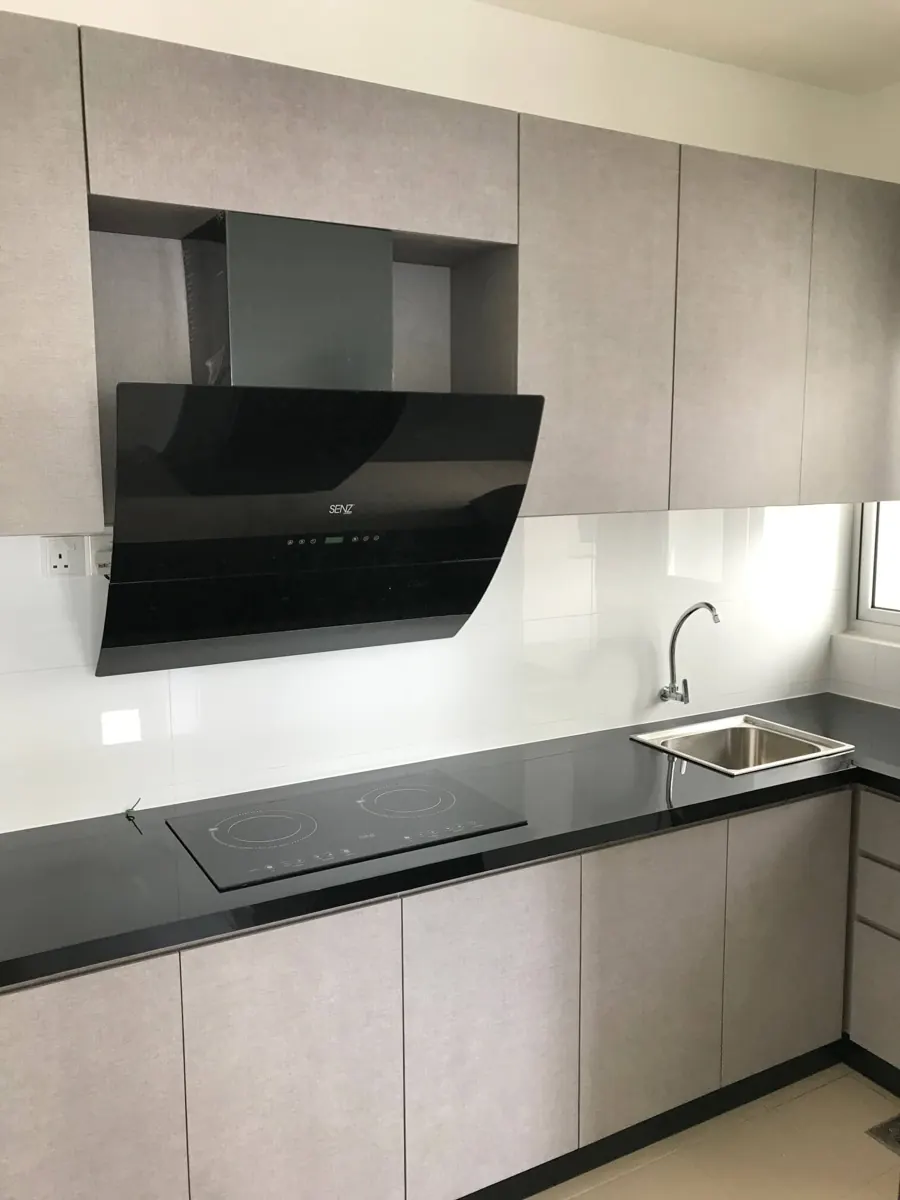
| Sink, tap, hob, hood, oven | No | Who supplies them, who cuts the openings |
| Moving plumbing and power points | No | Who does it, and when |
| Delivery, installation, removing old cabinets | Varies | Written in the quote by name |
Set aside some spare money too: PropertyGuru Malaysia's 2026 guide recommends a buffer of 10 to 20 percent of the renovation budget. In a kitchen, it often goes on plumbing that is not where the drawing showed.
The countertop deserves its own line. AmpQuartz (2026) lists quartz at RM70 to RM190 per square foot and granite at RM10 to RM500. Our quartz vs laminate countertop guide compares the two most common choices.
What should I ask before signing a kitchen cabinet quote?
Ask questions that turn a single rate into a list you can compare line by line. These ten cover most of the gaps we see.
- How many running feet for the base row, and how many for the wall row?
- How is the corner counted?
- Which board is the carcass, and what thickness?
- Are all cut edges sealed, including the pipe holes in the sink cabinet?
- Is the back panel grooved in, or stapled on?
- Which brand of hinges and drawer runners, and are they soft-close?
- How many drawer stacks are in this price?
- Are pull-outs, corner units and bins listed separately?
- Is the countertop included, with area, thickness and cut-outs written out?
- Who makes the cabinets, and can I visit where they are made?
The last question matters. If the person quoting passes the work to another fabricator, there is a margin you cannot see, and the details you agreed may not reach the people building it.
Comparing a custom kitchen with a flat-pack one? Our custom kitchen vs IKEA guide covers that choice.
Getting a price for your own kitchen
We measure, draw every cabinet, and cut and edge-band each board ourselves at our Galla Industrial Park workshop. Installation is done by those same people, not an outside crew. Send us your floor plan or a few photos of the space, and we will reply with a line-by-line quote that answers the ten questions above.
WhatsApp us at +60 13-338 6813, or see how we build kitchen cabinets in Seremban and on our kitchen cabinet service page. You are welcome to visit the workshop and see the boards before you decide.
Common questions about this topic
What is the kitchen cabinet price per foot in Malaysia in 2026?
AmpQuartz (2026) publishes RM290 to RM600 per running foot for melamine-faced cabinets, RM330 to RM600 for solid plywood and RM400 to RM700 for aluminium. These are third-party market ranges, useful for checking a quotation you already have. They are not Fatt Interior prices, and the board alone does not decide where a kitchen falls inside them.
Does a per-foot price count the top and bottom cabinets together?
Usually not. A running foot is one foot of cabinet length along the wall, counted once for the base row and again for the wall row. A wall with cabinets above and below is therefore counted twice. Ask the workshop to write base feet and wall feet as two separate numbers before you compare rates.
How much does a full kitchen cost in Malaysia in 2026?
PropertyGuru Malaysia's 2026 guide puts a whole kitchen at RM10,000 to RM100,000, depending on size and finish. Fatt Interior publishes its own bands: a compact 10-ft kitchen with base and wall cabinets and a laminate top starts from about RM 9,000, and larger or L-shaped kitchens with quartz or sintered stone tops commonly run RM15,000 to RM50,000.
Is the countertop included in the cabinet price per foot?
Almost never. Countertops are priced per square foot, not per running foot. AmpQuartz (2026) lists quartz at RM70 to RM190 per square foot and granite at RM10 to RM500. Sink and hob cut-outs, up-stands and thicker front edges are often separate lines, so ask for the top to be written out on its own.
Which cabinet material is best for a Malaysian wet kitchen?
Fatt Interior recommends a plywood carcass with a laminate (HPL) finish, with every cut edge sealed and the base cabinets lifted off the floor on legs. Plywood holds screws well and copes with damp far better than particle board. Aluminium is another option on the market, but it is not something Fatt Interior builds.