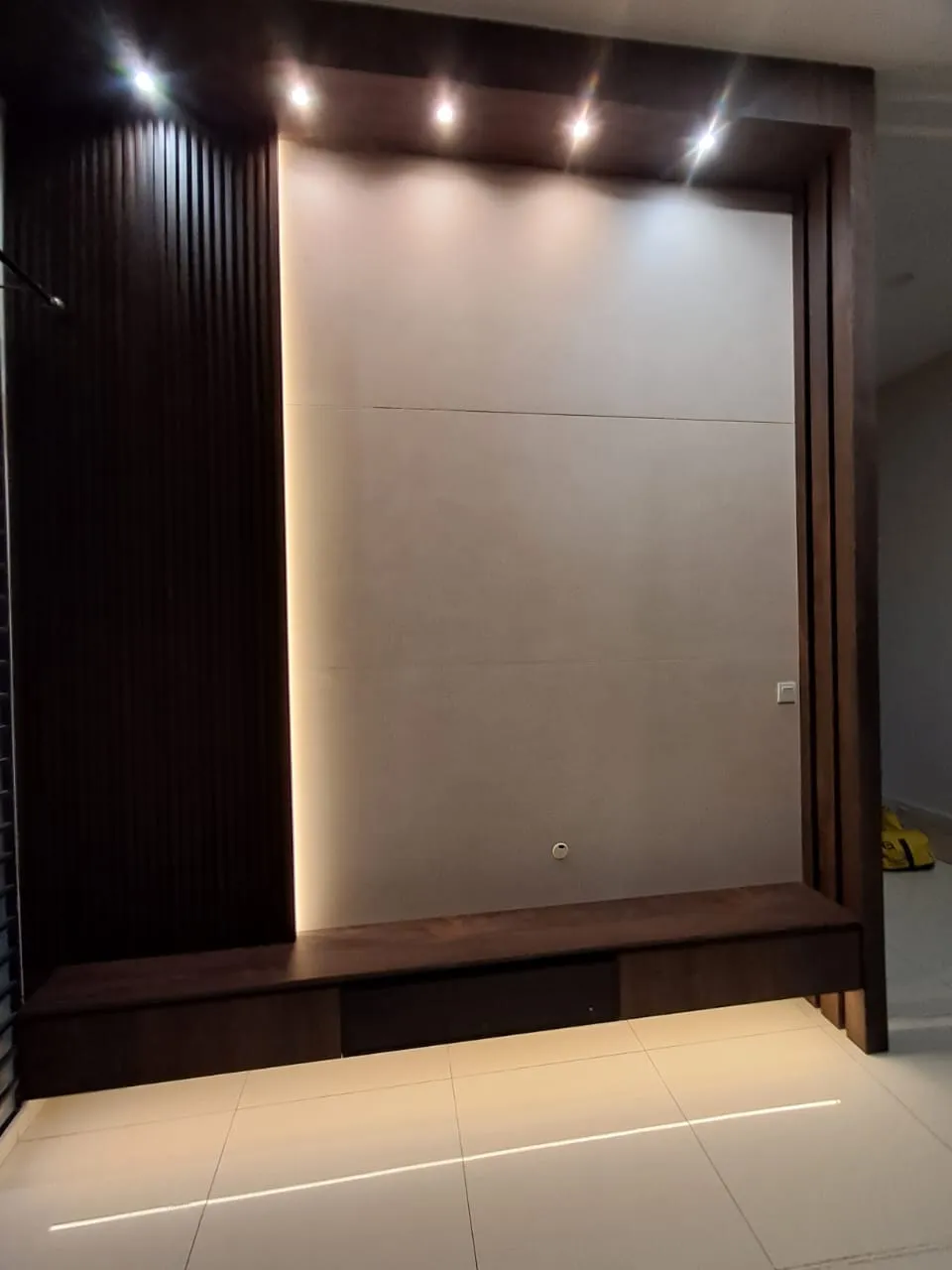
A built-in TV feature wall in Malaysia can cost a little over a thousand ringgit or several times that, and the gap comes from four things: how wide it is, how high it goes, whether there is a cabinet underneath, and how much lighting it carries. At Fatt Interior, a simple 8-ft TV wall board with LED lighting starts from RM1,300. A full-height wall with slats, a drawer cabinet and downlights costs a good deal more.
For a market reference, PropertyGuru Malaysia's built-in furniture guide (2026) puts a basic built-in piece at RM3,000 to RM6,000 on average. Your own price comes after we measure, and depends on size, material and design.
In short:
- A plain backing board with LED is the cheapest kind of TV wall.
- A lower cabinet with drawers is usually the biggest single addition.
- Full-height walls, slats, side fins and downlights all push the price up.
- Ask for a quote that lists board, cabinet and lighting as separate lines.
How much does a TV feature wall cost in Malaysia?
At Fatt Interior, a simple 8-ft TV wall board with LED starts from RM1,300. That covers a flat feature board behind the TV, not a cabinet. Anything beyond that is priced after we see the wall, because two walls of the same width can need very different work.
The market figures we can cite are broad. For one basic built-in piece, PropertyGuru Malaysia (2026) lists an average of RM3,000 to RM6,000. For a whole living room plus bedrooms, its 2026 renovation guide lists RM10,000 to RM70,000, and the top of that band is where carpentry-heavy jobs sit. That covers far more than a TV wall, so use it only as an outer limit.
What does a TV feature wall include?
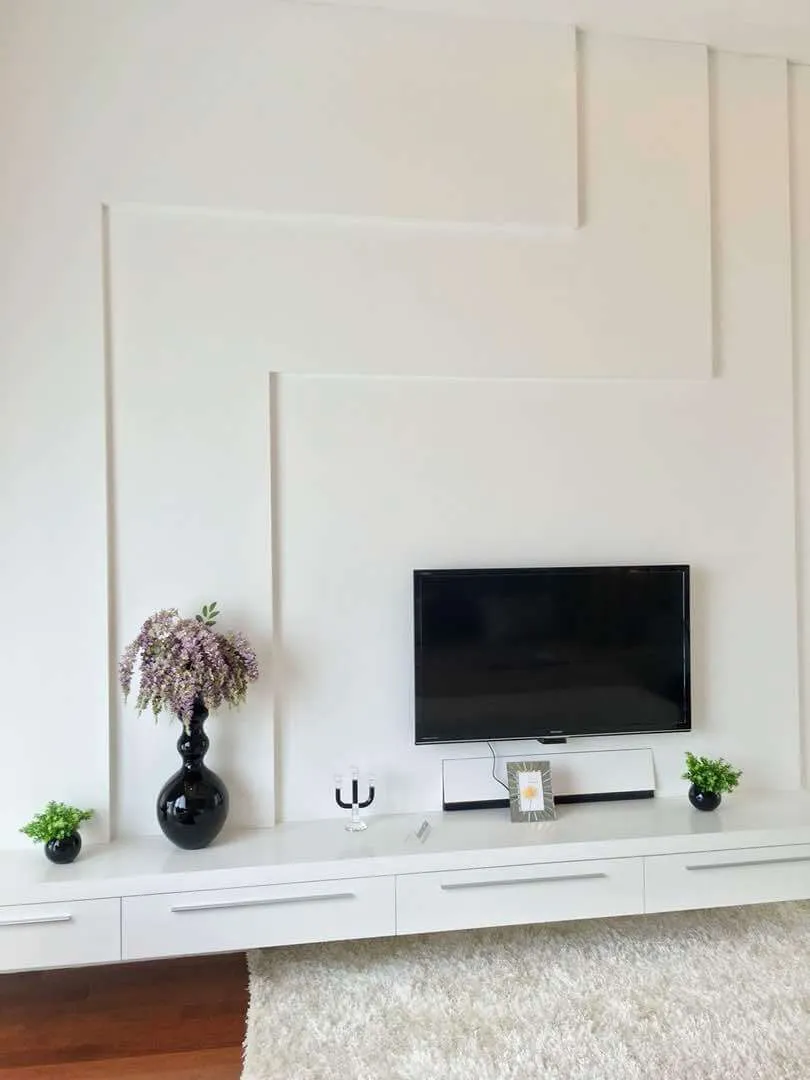
A TV feature wall has up to four parts: the backing board behind the TV, the lower TV cabinet, side panels or slats, and lighting. A quote can include all of them or only one, so check which parts you are being priced for.
- Backing board. The panel the TV hangs on. It hides the wires and gives the wall its colour or texture.
- Lower TV cabinet. A floating or floor-standing unit for the decoder, console and router, usually with drawers or flap doors.
- Side panels, slats or fins. Vertical fluted slats or a few deep fins frame the wall and make it look built in rather than added on.
- Lighting. LED strips behind the board or under the cabinet, and sometimes downlights set into a top frame.
Things that are often left off or priced separately: removing an old cabinet, moving a power point, a bracket for the TV, and patching the wall around it.
What makes one TV wall cost more than another?
Height, the lower cabinet and the lighting make the biggest difference. Width matters too, but most living rooms fall within a fairly narrow range of widths, while height and add-ons can double the amount of work.
| Choice | Lower-cost option | Higher-cost option | Why it costs more |
|---|---|---|---|
| Height | Board up to about the top of the TV | Floor to ceiling with a top frame | More board, a frame to build and more time on site |
| Cabinet | No cabinet, or a slim open shelf | Floating cabinet with drawers | Carcass, drawer runners and hanging it level on the wall |
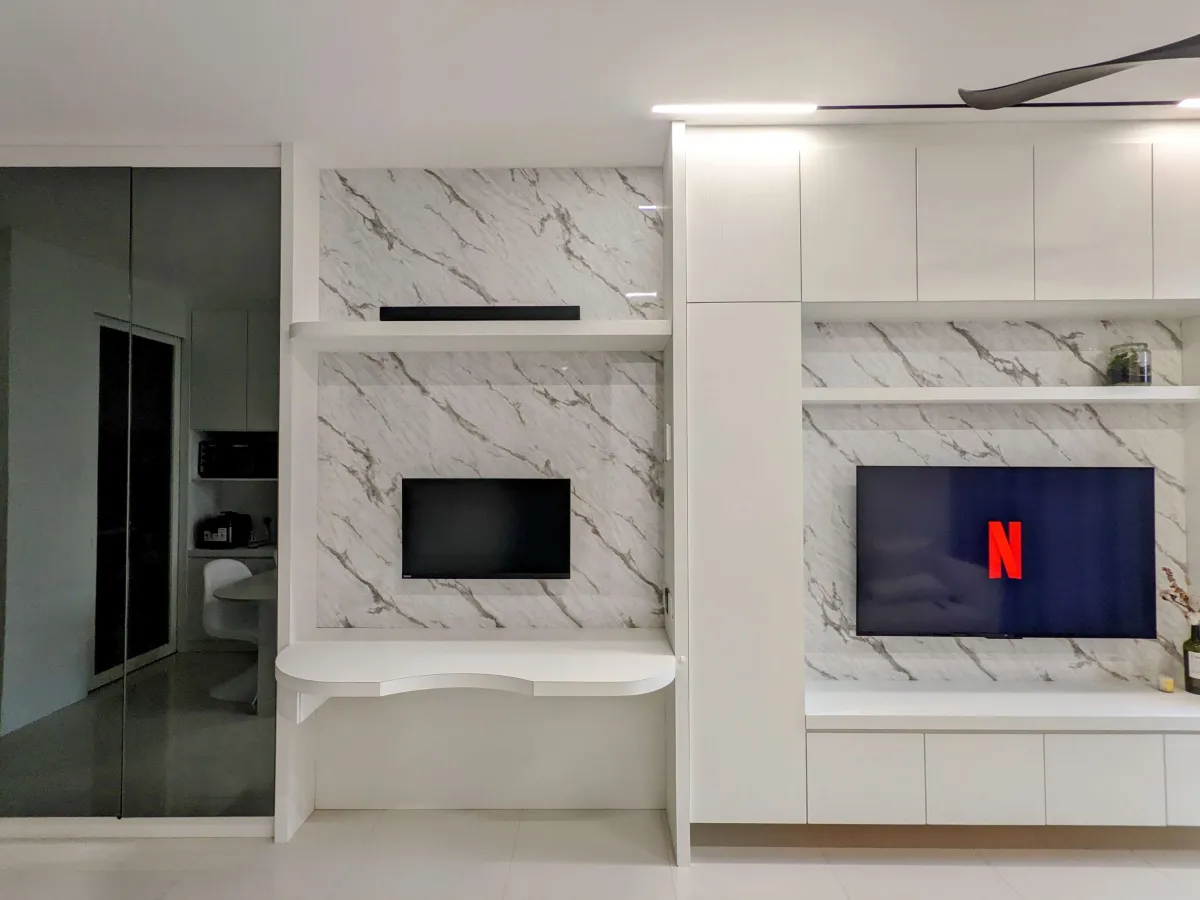
| Surface | Flat laminate board | Fluted slats, fins or stone-look panels | More pieces to cut, edge and line up |
| Lighting | One LED strip | LED strips plus downlights | More fittings, wiring and a frame to hold them |
| Storage | TV wall on its own | Display shelves or tall cabinets each side | Each extra unit is a piece of carpentry on its own |
What did we build for a TV wall in Tampin?
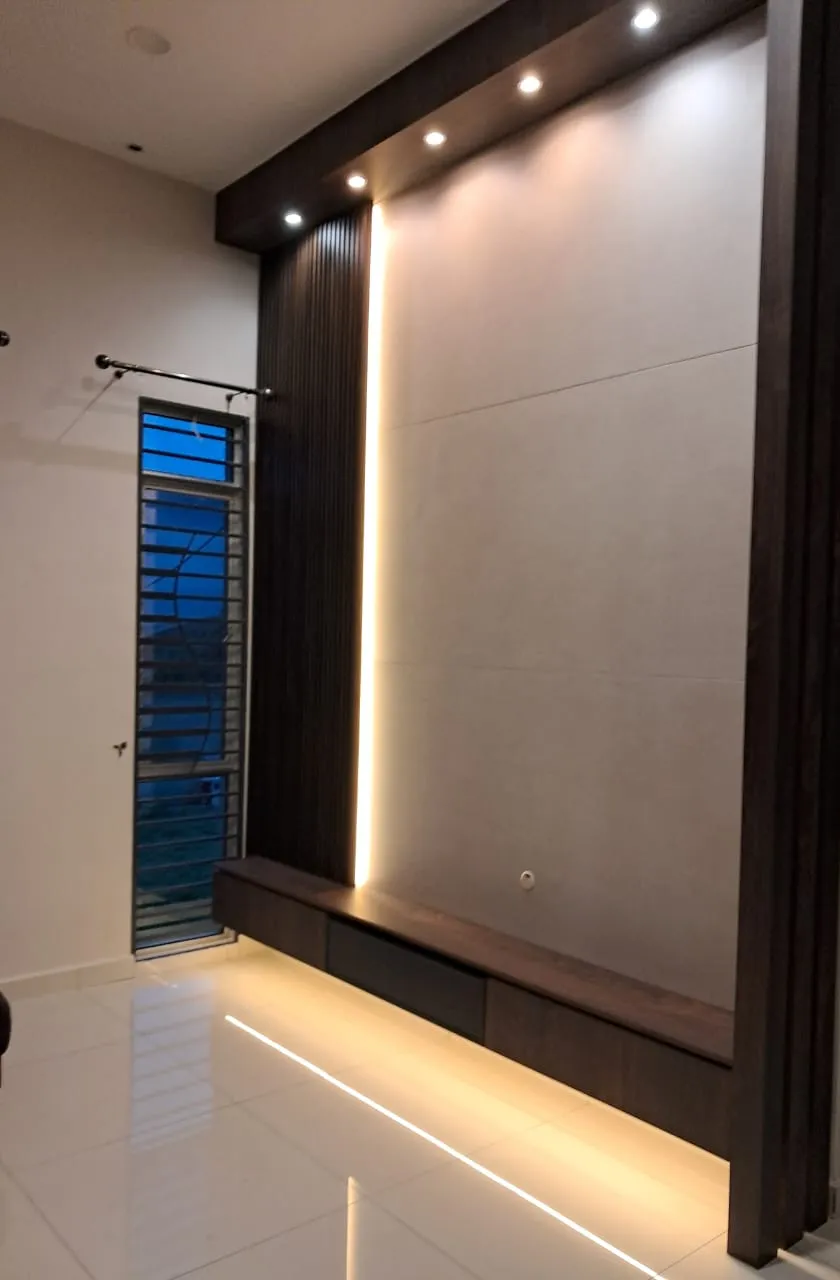
In October 2026 we built a full-height TV feature wall for a landed house in Tampin, Negeri Sembilan. The wall is about 3.3 metres wide and close to 4 metres high, so a board that stopped at the top of the TV would have left a large empty wall above it.
What went into it:
- A dark walnut laminate frame around the whole wall, with downlights set into the top section.
- A light stone-look panel in the middle, where the TV hangs.
- Vertical fluted slats on the left and three deep fins on the right.
- A floating TV console with three drawers.
- LED strips along the slats and under the console, so the floor below it is lit.
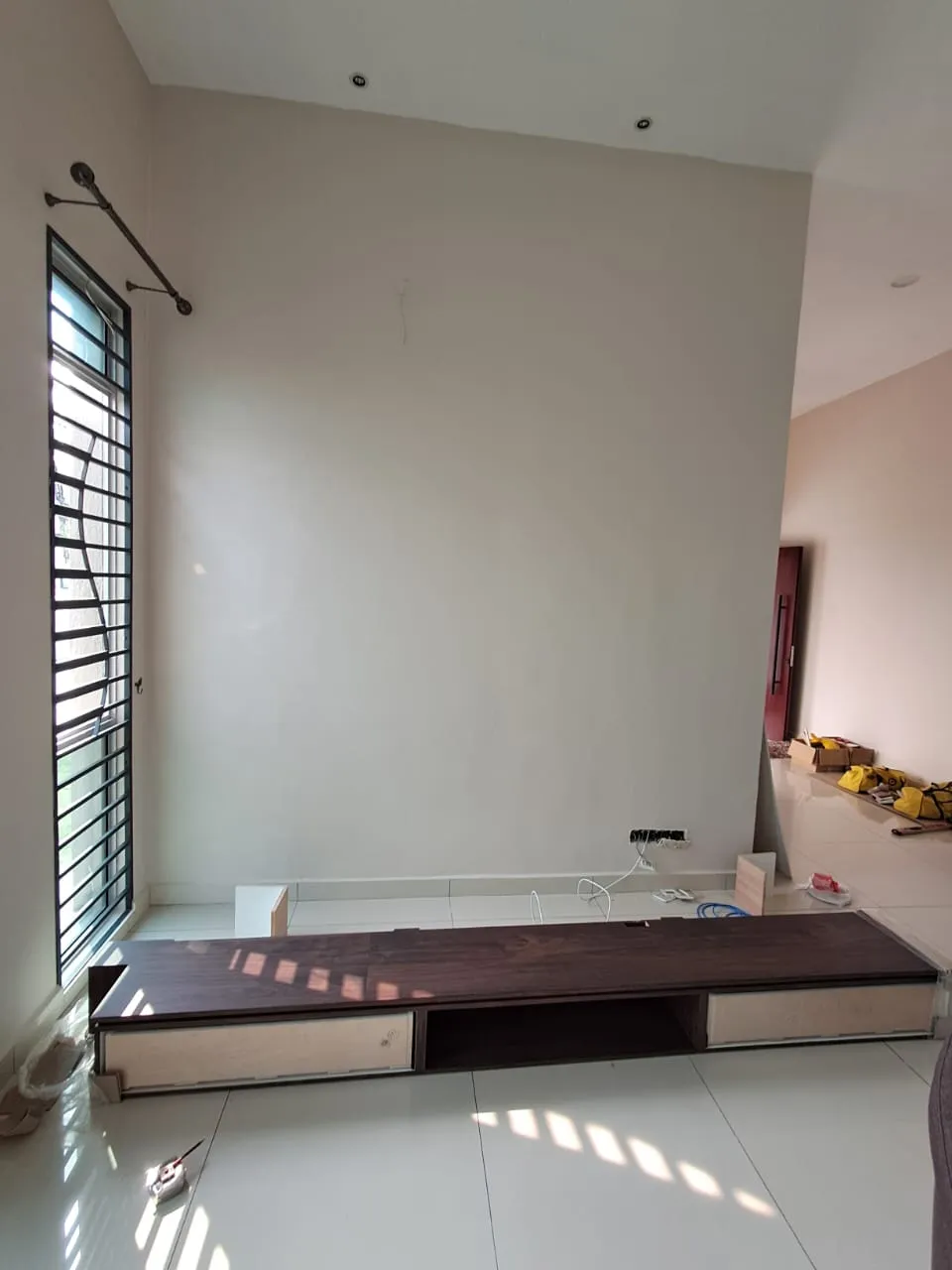
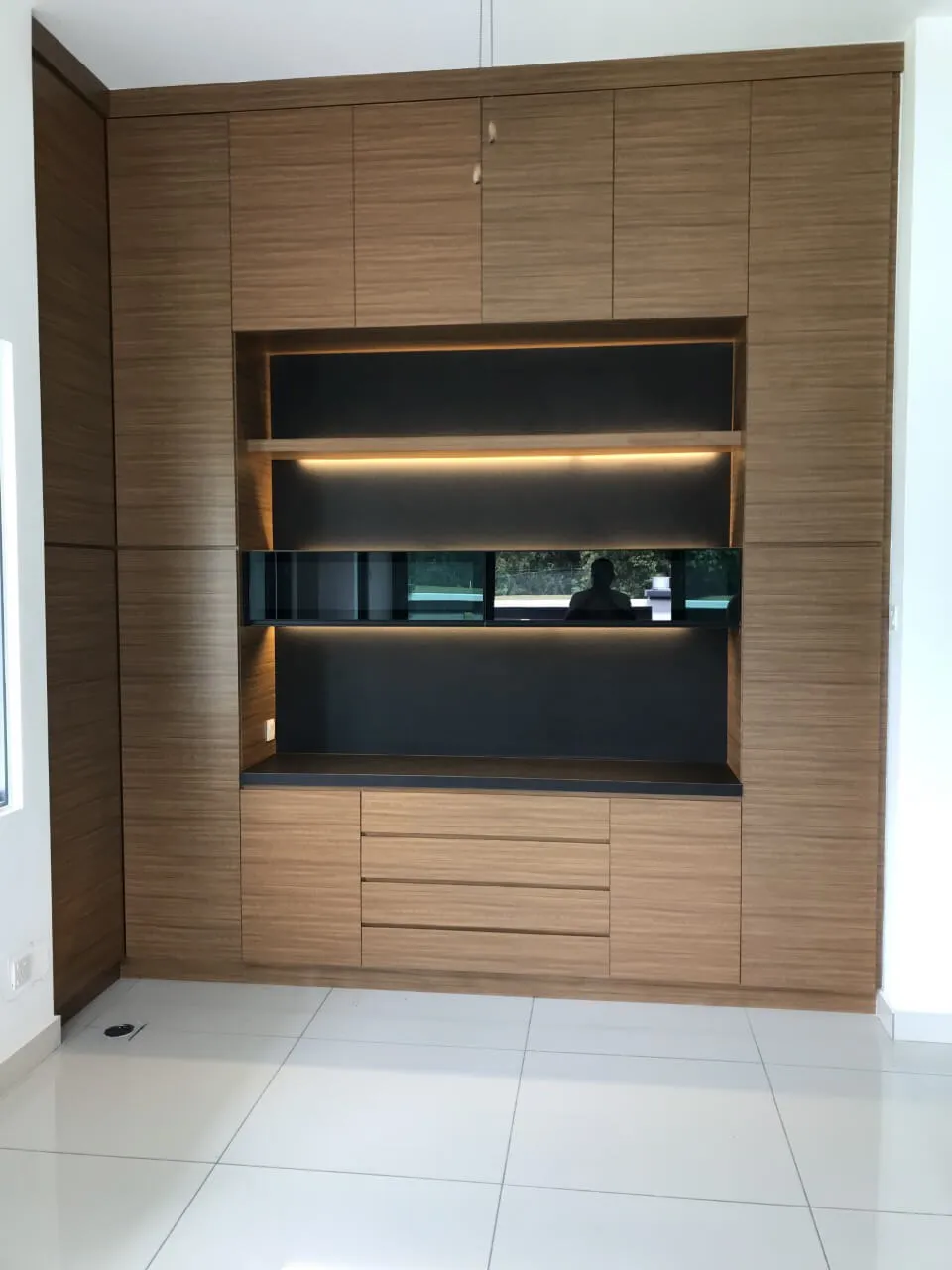
All of it was cut and edged in our workshop, then installed on site. The cabinet carcass was built first and brought in before the frame went up, which is why the before photo shows it on the floor.
This is the kind of wall that sits at the top of the price range in this guide: full height, slats, fins, a drawer cabinet and two kinds of lighting. A flat board with a single LED strip, like our 8-ft starting option, is a much smaller job.
Which material should a TV wall use?
We build TV walls and TV cabinets in plywood with a laminate (HPL) finish. Plywood holds screws well, which matters for a cabinet hanging off the wall and for a TV bracket fixed through the board. Laminate is hard-wearing and comes in woodgrain, stone-look and plain colours.
Living room walls in Malaysia face their own problems. An external wall that takes the afternoon sun can stay damp behind a board, so we keep the board slightly off the wall and seal every cut edge. Our material selection guide compares the common boards, and hinge and edge-band choices are in the custom cabinet guide.
How do you measure for a TV feature wall?
Note how wide the wall is, how high the ceiling sits, and where you find every power point, switch, window and door near it. Also note the size of your TV and where you sit, because that decides how high the TV should hang.
A few tips before asking for prices:
- Take the width near the floor, at waist height and near the ceiling. Use the smallest of the three.
- Photograph the whole wall, including the ceiling line and the floor.
- List what has to go in the cabinet: decoder, router, game console, speakers.
- Decide whether the wall stops at the TV or runs to the ceiling.
Use your own numbers to set a budget, and let us take the real ones after the plaster and paint are dry. If you only have a floor plan, the scale rule tool helps you read it, and our guide on why finished cabinets differ from the 3D design explains what to expect from a render.
What should you check on a TV wall quotation?
Check that the quote names each part separately, so you know what you are paying for and can compare two quotes fairly. A single total for "TV wall" can hide a missing cabinet or lights.
Before you pay a deposit, ask:
- Is the backing board full height, or does it stop at a set height?
- Is the lower cabinet included, and how many drawers or doors?
- What board and what finish: plywood, laminate, something else?
- Are the LED strips and downlights included, and who does the wiring?
- Is removing the old cabinet included?
- Is moving a power point or switch included, or extra?
- When will the final site measurement be taken?
Get a TV wall quote from our workshop
We measure your wall, draw the layout, then build the wall unit at our Galla Industrial Park workshop and fit it ourselves. You can see more of this work on our custom furniture page. If you are planning a TV wall in Seremban, Negeri Sembilan or the Klang Valley, send us the wall width, the ceiling height and a few photos on WhatsApp, and we will tell you which kind of wall suits the room before we price it.
Common questions about this topic
How much does a TV feature wall cost in Malaysia in 2026?
It depends mostly on width, height and whether a TV cabinet sits underneath. At Fatt Interior, a simple 8-ft TV wall board with LED lighting starts from RM1,300. Adding a lower cabinet with drawers, taking the wall up to the ceiling, adding slats and downlights all raise the price. For context, PropertyGuru Malaysia's built-in furniture guide (2026) gives RM3,000 to RM6,000 as the average for one basic built-in piece. We give a firm figure only after measuring the wall.
Is a TV feature wall priced per foot?
Usually the width is measured in feet and each part is priced against that width: the backing board, the lower cabinet and any side panels. Height matters too, because a wall that runs to the ceiling uses more board and needs a frame at the top. Lighting is normally added as a separate item. Ask the workshop to show each part on its own line so you can see where the money goes.
Is a built-in TV cabinet cheaper than a ready-made TV console?
No. A ready-made console from a furniture shop costs less, because it is made in volume to a fixed size. A built-in TV cabinet costs more but is cut to your wall, so it fills the space edge to edge, hides the wiring and can carry a backing board, shelves or lights. If your wall is a standard width and you only need a low bench, a ready-made unit may be enough.
Should the TV wall go all the way up to the ceiling?
It looks best in rooms with a high ceiling, like the double-volume living rooms in many newer landed houses, where a short board leaves a large blank wall above it. It costs more because there is more board and a top frame to build. In a condo with a normal ceiling height, a board that stops around the top of the TV is often enough.
How do you hide the TV wires in a feature wall?
The wiring route is planned before the board is cut. The backing board sits slightly off the wall, so cables can run behind it from the TV bracket down to the cabinet, through a small grommet hole. The power point and any switches need to be agreed before installation, because moving them after the board is up means cutting into it.